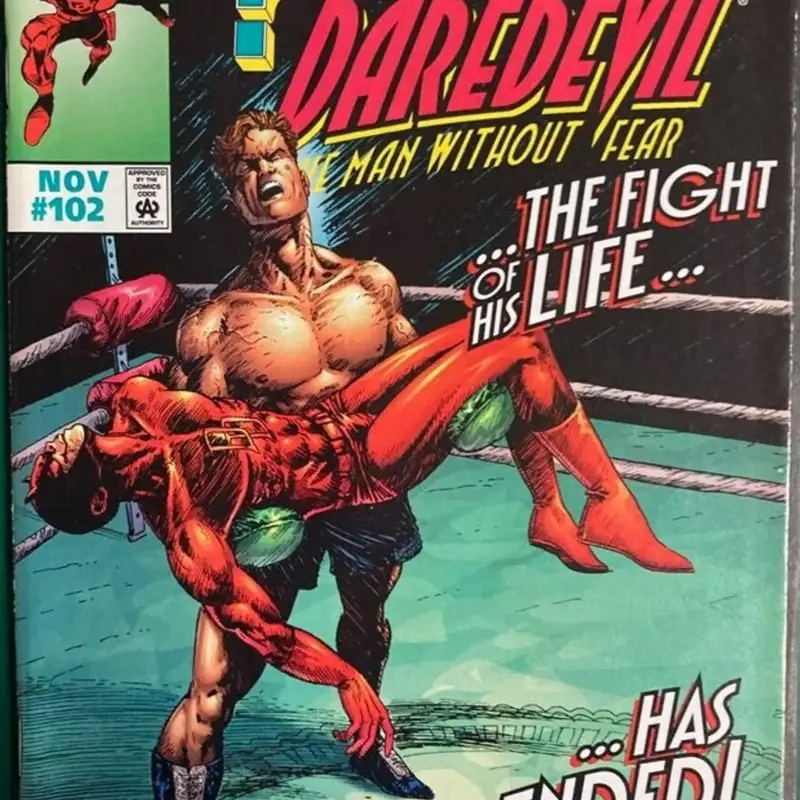
What if Daredevil’s dad had thrown the big fight? From Marvel Comics' What If #102
>> Rob: I double dog Daredevil, you to listen to this episode about the man without fear. It's Dear watchers at Omniversal comic book Podcast, where we do a deep dive into the multiverse.
>> Guido: We are traveling with you through the stories and the worlds that make up an omniverse, of fictional realities we all love. And your watchers on this journey are. Me, I'm going with Batlin, Guido, and
>> Rob: me, Rob, the Man without Ear.
>> Guido: Like Van Gogh, but it's not accurate.
>> Rob: How do you know? The listener doesn't know that I can see your ears. That's true. Okay, still, you spoiled it. Well, battlingito, before we begin our little trip through the multiverse, what's happening in our little section of comic bookdom?
>> Guido: Well, we're back again and we're here with a classic. This is how we got our start, what if Multiversal stories. So it's nice to return to it. I don't know when the last time we did a what if was, but it's been a while.
>> Rob: Yes, we said what if? We do a what if episode.
>> Guido: And it's timely because of a TV show coming out in the just about a month's time from when we're recording this. But in the meantime, a reminder that you can catch us on our alternating weeks at the Sleepover Retro countdown show, which also is a video podcast. But we appreciate you being here with us to talk about comic book multiverses.
>> Rob: Yes. And if you're joining us for the first time, we have three parts of our journey through the multiverse today. Origins of the story, exploring multiversity, and pondering possibilities. So thanks for coming along and remember,
>> Guido: we still value your 5 star reviews and you finding us on social media earwatchers.
>> Rob: And with that, welcome to episode 176. And let's check out what's happening in the omniverse with our travels today's alternate universe. Today we are entering the ring to answer the question, what if Daredevil's dad had thrown the big fight?
>> Guido: I think it's funny that this question is dad instead.
>> Rob: Father, Papa, Patreon, Daddy, Daredevil's daddy. That's a whole different comic.
>> Guido: So this is a real what if question from that gives us a whole separate Earth. Earth 9711. And we have covered Daredevil, but not as much as it feels like we would have over five years and nearly 200 episodes. We first covered Daredevil way back on episode eight when we explored what if Bullseye had not killed Elektra? And then not too long ago on episode 154, when Daredevil teamed up with Batman, which was the first time we actually talked his origin in depth, because our focus was Elektra way back then. So it is exciting to get back to the man without Fear.
>> Rob: Not to be confused with me, the man without Ear. But Guido, I know we've talked about it before, but what's your background with Daredevil?
>> Guido: He's always been on the periphery of, books that I've enjoyed. I read daredevil in the 90s just because I was reading everything Marvel, as a Claremont fan, as an Anna Senti fan, as a Frank Miller fan, I would slowly read portions of Daredevil stories. But it was actually when the Netflix show started. So what is that, 2015? Maybe something like that, that really inspired me to do a deep, dive and read pretty much the whole Bronze Age 80s run. And I loved it and read and get into Elektra. And then ever since the modern incarnations, I've read particularly Chip Zdarsky's Run and Brian Michael Bendis Run. So I'm, moderately familiar. I'm certainly not fan level familiar, but I'm pretty well versed in Daredevil. Don't own any Daredevil toys or anything like that. So what about you?
>> Rob: Well, I always loved the Kingpin a lot, so I would pick up old issues probably of the Frank Miller Run with Kingpin on the COVID But the problem was you couldn't just pick up a random issue because those stories were so.
>> Guido: Oh, it was so. It was. It was such a good giant arc, which is what I discovered and I loved when I got into it is like X Men. It just goes on and on and on and on and on. It's a soap opera.
>> Rob: But I think that was one of the reasons why I couldn't get into it, because you just couldn't get a single issue and kind of enjoy like a standalone villain of the week. So he was never someone I really got into again until I really watched the Netflix series. But I've never delved deep into the comics, even for this podcast. As you said, he's been someone who's been a bit on the periphery. So let's talk his origin or origins of the story. Right now on this very show, you're gonna get the answer to all your questions. Our amazing story begins a few years ago. So let's talk Daredevil because we reread his origin.
>> Guido: Yeah. Which we covered already. It happens in issue number one. And I Think we talked about this the last time we talked about him all those many years ago. But his. His origin has stayed almost M. Completely the same. M. Which is unusual because even when you get someone like Spider man, even that's been modified at times with exactly how it happens and the Spider and the Uncle Ben stuff. But Daredevils is just completely faithful to that original one. Yeah.
>> Rob: The one big difference that you get in that first episode is the yellow suit, which I'm actually kind of partial for. Of course, it doesn't really go with the devil theme. And if you're haunting criminals at night, you probably don't want to be in a bright yellow outfit. But I do love the look that's been, I guess, the one big change from then till now.
>> Guido: Yeah. And it happens early on, and obviously they've brought back the yellow suit, and then there was the black suit of the 90s.
>> Rob: But even in that first issue, he still has the cane, baton, weapon, like all that is introduced in issue number one.
>> Guido: Yeah, it's really incredible that it's all there on the page, and then it stays pretty consistent through the TV shows, which we've watched almost all of. We waited for a long time to watch Born Again, in part because it was the lowest point of my Marvel cynicism cycle, I'd say, which I'm not fully out of, but I'm crawling out of. And with Jessica Jones on the horizon, we had to watch Born Again. So we actually haven't even finished Born Again, but we are about halfway through it otherwise. We were big fans of the Netflix shows for all their imperfections, of which there are plenty. And so why is he popular? But he's an interesting level of popularity because he doesn't break out like even Iron man blew up. M. Iron man was a smaller character than Daredevil, but has blown up. So Daredevil is an interesting one where if you pull someone off the street, have they heard of Daredevil? Maybe. But they probably couldn't tell you very much. If they can tell you anything, it's that he's blind. But that might be about it. Yeah. So it's an interesting.
>> Rob: One of the reasons why I think Iron man blew up as well as, of course, Spider Man. It's always been popular in various members of the X Men is they have a lot of humor to their characters. And even then when Thor kind of emerged or changed in the film versions, he had a lot of humor. Daredevil, both on the Netflix series and what I'd imagine in a lot of the comics, especially knowing and in the Ben Affleck film. But knowing Frank Miller, like comedy and Daredevil are not two things. He's like closer to Batman almost Demeter in that way.
>> Guido: Yeah, that is definitely true.
>> Rob: Even his powers are very bat like, actually.
>> Guido: Yeah. Which is why he teamed up with Batman, as we covered just last year. But would you. Do you like him as a character? We've talked about our backgrounds, but do you like the character?
>> Rob: Well, I think one of the things that is so key to the character is him having this disability and the fact that other characters, if you think of Tony Stark, is a billionaire, so he doesn't have many disabilities. You know, Peter Parker is still a smart guy, but Daredevil, in his normal life, is this blind man. So having that as a comparison to being a superhero, I think is something that makes him stand out within the Marvel universe and probably makes him relate. More relatable than a lot of these other characters.
>> Guido: Yeah, it is closer to the Thing or a mutant on the X Men who has powers that are in some ways creating a challenge to life. And even if you don't put in the supernatural aspect of his heightened senses, it still makes for a very interesting story, obviously, to have this fighter, who is blind, which is certainly possible. Again, even I think that's also what works really well for him, is he's not quite supernatural. Like, you do hear, in real life about people having heightened senses when one sense is more restricted because it's just how they experience the world and how they take in information and interact with the world. So it's a really clever origin in that even though it's obviously done to an extreme, it is a little bit more believable. It's not as fantastic as the Fantastic Four getting bombarded with cosmic radiation or a mutant developing a superpower. Yeah, I think he's a little bit more human like Spider man is. But even Spider man at times can, you know, crawl up walls. So he's quite a human hero, which, again, makes him more akin to Batman.
>> Rob: M. But while Batman, of course, is ultimately this billionaire, also with unlimited resources, I think even how we see Matt Murdock, especially on the TV series, is someone who is very much of the people. He is not one of these other characters that is like living in the lap of lunch.
>> Guido: No, he has a day job.
>> Rob: He has a day job.
>> Guido: And so much of the. The story is about his day job, both in the comics and in the TV show. And it's part of what I enjoy. So Much is you're watching a legal procedural that is not exclusively about his being a superhero. It often intersects, of course, because that's what makes for interesting stories. But I like that he keeps a day job, has a whole life outside of his superhero. Dumb.
>> Rob: And I think another thing with him that stands out, and maybe you'll say I'm wrong about this, but I feel like not as many of the Marvel characters, Marvel heroes have a true arch villain. Like, if you think of Spider man, yes, there you could say it's the Green Goblin, but he's got Dr. Octopus and other characters like, you know, Thor, it's Loki. But those Magneto. But those characters come and go as villains and heroes. I think one thing that makes Daredevil stand out is the Kingpin as another. As his adversary, as another human being, as another character that does not have powers, that is basically surviving on his wits and his human strength. And I think having that as this arch enemy is such a key to the character as well.
>> Guido: Yeah, I agree, because as you mentioned, in your background, he is Kingpin is a very popular character. And in particular, with Vincent d' Onofrio's portrayal, I'd say he's become increasingly so. So it does make for a really good companion to Daredevil. So let's get into some twists to Daredevil's background.
>> Rob: Yes, we'll talk about what if on Exploring Multiversity. I am your guide through these vast new real. Follow me and ponder the question. What if? And on this episode, we are asking the question, what if Daredevil's dad had thrown the big fight? This is from what if 102, of course, from Marvel Comics, released on November 1997.
>> Guido: Yes. And this is written by Bill Roseman, penciled by Hector Collazo, inked by Ian Aiken, colored by Shannon Blanchard, lettered by Chris Eliopoulos. This is, of course, late in volume two of what if, where there's not even a question on the COVID but this one actually does have a question on the inside gatefold that gives a full summary, which I love that they were doing, but a little more on the creators here, here. So really fascinating to know that Bill Roseman is known mostly for editing. He only wrote 27 books. Oh, wow. And he is now one of the highest up in Marvel Studios people. Oh, wow. He's the vice president of gaming and edited almost every MCU movie and game adaptation, or edited on them. So he really transitioned from comics to the studios and video games. And it's cool to See, a story that he created, he wrote very little. Again, just a couple dozen things. So that's Bill Roseman and his collaborator on the art did very little work for Marvel. He only drew, less than 20 different things. And that's about all that I found. So this is the era of, again, what if. Where? There. It's great. They're trying out new talent, but also sometimes they're trying out random, people who they find. I don't even know how they approached it. But let's get a quick summary, because this world is very different and not that different.
>> Rob: Yeah, well, it feels like it has this classic kind of film noir structure, because we're seeing the story is all flashbacks. So it's framed by a Ben Urich reporting. And he is actually, interviewing Matt, and Matt is telling us the story. So everything is the same as the 616 until Jack Murdock, Matt's father, throws the big fight. And Matt then goes to, Columbia.
>> Guido: Well, he throws it to pay for him.
>> Rob: To pay for him to go to Columbia.
>> Guido: So this is the point of divergence, because in the 616, Jack refuses to throw the fight so that his son can look up to him. And then, of course, he gets killed. And that's what creates the Daredevil. So here, he doesn't throw the fight, Matt goes to Columbia, and everything else remains pretty much the same at this point, except he's not Daredevil. So he meets Foggy, he meets Elektra, but he doesn't become a lawyer, he becomes a boxer.
>> Rob: Yes, that's because his dad, obviously, is not dead and continues to fight, and he continues to get beaten up, and then eventually goes in a coma. Matt needs to pay for his medical bills, so he decides to become a boxer. But who is his manager? Who is his financier, agent? It's Wilson Fisk. And kind of a similar arc to his dad. He's winning all these fights until Fisk then asks him to, throw a fight. Throw a fight.
>> Guido: To take a nap, I think. Take a nap.
>> Rob: Yes. And Matt, like his dad in the 616, does not do that. And Fisk actually kills Jack there. Jack Murdock.
>> Guido: And so they become nemeses. And Matt trains with Elektra, who has learned all of the. Everything from the hand. Cause again, everything else in this universe stays the same. Matt, as a proto Daredevil, goes to confront Kingpin, and. And Elektra comes along and murders him with her size. And Matt takes the fall. Matt puts his fingerprints on the Size. And we find out that Ben is interviewing him, in prison. And Ben knows he's innocent because Ben has pieced together that Elektra uses size. So of course it was her. But Matt decides he's going to take the fall.
>> Rob: And this is all kind of to take revenge in some way, for her father's death that happened years earlier. Not that Fisk is necessarily involved in that, but she's basically railing against the system, you could say.
>> Guido: Which is again, the same as the 616. So I loved this book. I thought this was a perfect. What if that was. Had a clear point of divergence, had a clear difference from the universe we know. And yet what I think that he did such a good job of in writing it is pulling it back. Almost that thing you want in alternate timeline stories where they're being pulled back to the sacred timeline, if you will. Like, there's this draw you imagine whether it's fate or destiny or something. And in this case, it's cool that it's inverted. It's cool that it's Matt who refuses to throw the fight decades later. And that that's what leads to him becoming Daredevil. And it's cool that I love the element of him, even taking the fall for Elektra. So there's this multiple layers of the story of taking a fall or not taking a fall and what that means. So it's quite a deep story for a very brisk, fast paced, light story, frankly.
>> Rob: Yeah. I like this idea that history repeats or that you can never get away from the arc of history, even in these alternate timelines. And I think one thing that's also that it does kind of harkening back to the 616 is that as a boxer, Matt has to pretend that he can see. And, that is basically what he does as Daredevil, only without a mask here. So I think, like, that is also a very smart decision. And it kind of plays with taking away, kind of almost the Clark Kent ness of Matt playing up his disability as we see. And if we were in the normal universe.
>> Guido: Yeah, yeah. And that's where it's really fun. I don't know if, if Bill Roseman was a huge Daredevil fan or just set out to do a good job of pulling in the essence of Daredevil's story into a pretty different story, but, I liked it. The art was very typical, 90s rushed, like a little exaggerated.
>> Rob: is he exaggerated? And also lack of detail at the same time.
>> Guido: Lack of detail. That's probably in the inking. Again, they were doing this cheaply, I'm sure. So it was not given the time or attention it could have been.
>> Rob: There's several times with like Matt's face or Wilson's face or Electra's face where any facial details. And I think the same thing, you know, with some of the story, as you said, is very brisk. So in fact, we're just told that, Kingpin has killed Jack Murdoch. We don't even see it like, so we're just told in the next panel. So it's not. I mean, it's certainly not required that we see it. It's fine as. As is. But I almost found it ever so slightly jarring when I read it where it was like, oh, wait, he's dead already.
>> Guido: Yeah. Yeah. So do you want to continue in this Earth? Would you want to continue to see what happens next for this Earth? 9711 Matt Murdock, Daredevil, who's imprisoned for Elektra's crime.
>> Rob: No, because I think, as we said, it actually ultimately is not very different from the 616 in that way. Like, yes, he's not a superhero, but I could see this same plot applying to. I could see Matt in the 616 also, covering up for Elektra and going to prison. Like, I don't think it's that different from what that character would ultimately do.
>> Guido: Yeah, there's echoes of this in other Daredevil plot lines. I even feel like in the TV show there was echoes of this, of her. Him covering for her at some point. So definitely it is so faithful to the 616. But it somehow avoids feeling like there are those what ifs that don't feel distinct enough. I'm not sure what it is about this one that he's able to achieve that balance so well because, essentially all it does is delay when he becomes Daredevil. But you're right, this creates a Daredevil story ultimately, and so there's not much further to go with it. So as much as I enjoyed it, I agree. I don't think there's anywhere else to go with it. Otherwise, you're going to start retreading. Then you'll start to feel like you're retreading 6M116 story here. It doesn't feel like. It feels like a good pastiche or whatever the word would be for what it's doing.
>> Rob: But at the same time, as we've frequently encountered with past what ifs, they often do Try to bite off more than they can chew in 30 pages. And I think they were very smart here to keep this story very succinct in that way and not try to, I don't know, reinvent the wheel in that. In that regard.
>> Guido: Yeah. Well, in some ways, because he's hewing so close to the 616, that makes it a little easier. I also like points of divergence, not only that are clear, but that have, like, a really interesting and compelling kind of butterfly effect.
>> Rob: Mm.
>> Guido: So this is such a simple thing. I mean, I guess it amounts to his father staying alive is ultimately what the question is. It's who cares if he throws the fight or doesn't throw the fight? But the point is, is he doesn't get killed. And we've seen that version of Spider Man's story being retold where, what if Uncle Ben had lived? That's an early what if also. So this is ultimately the same question. But I just like that something so small and simple has such a significant effect on, the arc.
>> Rob: There's a lot of similar DNA to that episode. That issue that we've covered, I think it was one of our first ever issues because that also is dealing with Spider Man, Peter Parker being a boxer or a wrestler as well. So I felt a lot of similarity to that. Also having this very strong convergence point, but also playing with the idea that the future or the different timelines are always going to be reached in one way or another.
>> Guido: Well, and I think what's so similar is how important it is to these characters that these deaths motivated them. So in both cases, by removing the death, you had to get to the actual motivator. And in this case, it ends up being his death, but just years later. So I think it works really well. I really liked this what if and recommend it.
>> Rob: Well, let's end by pondering some possibilities. Will the future you describe be averted? Averted? Averted? Guido, what are we talking about for our pondering possibilities?
>> Guido: Well, we didn't follow up with a comic book because we're just at the front of. At the start of the next phase of Daredevil in the mcu. So let's ponder that, because we have Born Again, Season two coming up again in about a month from when we're recording this at the end of March. It's coming out. All we know, especially because we didn't get to the finale of season one yet, even we know that Kristen Ritter is on.
>> Rob: But we did go to New York
>> Guido: Comic Con, where we saw Charlie Cox and Krysten Ritter. So we know that she's on it. We also know there's rumors now these could be completely unfounded, but they are very fun to think about that one direction they might be moving in is toward a Daredevil spot Spider man movie, and that they can actually use the Devil's Reign storyline with Wilson Fisk as mayor of New York to build toward that. And then obviously you could pull back in Luke Cage and have a lot of fun with that. But I think that's an interesting idea. So what do you want to see from Daredevil on the screen?
>> Rob: Well, I think it's been great going back and watching Born Again now after giving a little bit of time, because it is so much more of a grounded MCU than we had been getting in a lot of other things. And I think for us, as someone, as two people who love the MCU and then found it lost its way in some ways, I think a lot of that was because it was telling these bigger and bigger stories. It was getting a little bit more convoluted. I like that. This is really, really a very much a back to basics kind of story.
>> Guido: I challenge that a little because I don't think it's that it's convoluted. I think it's that it's poorly executed and convoluted. Because I, in fact, see this season is born again as pretty convoluted. It has A, B and C plots. Well, I think in some cases, kind of D plots. And the reason it works so well is because unlike the Netflix series, which are notoriously decompressed and just they stretch everything for way too long, this one has such a fast pace and is doing a really good job servicing each story. It feels so comic booky. So I don't think it's so much about how convoluted or not convoluted.
>> Rob: But I think there's a difference between convoluted and comp. And complex. And I think one thing that I've seen is complex is that you're basically following to where we are right now. You're basically following two characters. You're following Matt and Wilson. But I think there's been lots of others, especially off the Netflix series. And I'm thinking of the Jessica Jones ones where you're following all these side characters and they all have their own story.
>> Guido: But some of that is that you just didn'. Care. Because think about on here, they're setting up Muse. They dealt with White Tiger. We've already Seen Punisher, we know there's some conspiracy going on related to his
>> Rob: iconography through the eyes of the two main characters rather than. There's not a scene where those characters are basically absent. I would say.
>> Guido: I guess that part is true.
>> Rob: While, you know, previously you just spend the day with Karen.
>> Guido: I know. Yes.
>> Rob: And it's like, okay, well, we kill.
>> Guido: Trimming the fat of Foggy and Karen was a very good move here. But I agree. On the Netflix series, we would have spent a whole episode with Vanessa. Yes. And I love the Kingpin Vanessa storyline, but I don't need to spend 40 minutes with her or 40 minutes with Jon Bernthal just to learn where he is now and set up the special that's coming out for him later this year. So I think it is very efficient. I agree.
>> Rob: Why do you find that this is a character now is on going into his fifth series. Has had an appearance and this is,
>> Guido: this is going to be record breaking because he was renewed for a third season and no MCU show has had a third season.
>> Rob: Yeah. And is appeared in one movie, albeit like basically a cameo. As you mentioned, might have another movie on the horizon. Like, why do you think this character Charlie Cox's performance has lasted when so many others have not?
>> Guido: Maybe because. Well, A, it's probably on the cheaper side, so that probably makes a difference. It's not as expensive as even like a Wonder man could be if they wanted to keep telling his story. Having just watched that and enjoyed that. I think also there was so much untapped potential. I think everyone loved the Netflix series, and yet I don't think anyone thought they were perfect. I'm sure someone did. But I think most people recognized that they were imperfect. So that gives the opportunity to go mine these characters. I think the same thing with Jessica and Luke. I think why we're all excited at the possibility that all these Netflix characters are going to come back is because there's just so much untapped potential that. That really got messed up in that project. So I think that's another reason. I also think for some people, I don't think this is a part of it for me. But there's that street level thing that people like. People like a street level hero. And Spider man is sort of a hybrid, but everyone else is a fantastic cosmic superhero. And so the universe doesn't have too many street level right now.
>> Rob: Yeah. Yeah. And even some of the better MCU projects like Black Panther and in this big melee where there's just a lot of cgi people like shooting at each other. And we've seen that in so many movies. And I think this is a series that. That obviously is never going to happen. And so I think in that way, as you said, the street levelness kind of brings it down to emotions and actors and stunned people and less of a. Obviously there's lots of cgi, but a less of an emphasis, at least on you. You don't watch this and think, oh, I'm just watching people standing in front of a green screen. Which is what you do if you're seeing most of the films.
>> Guido: Yeah, yeah, I agree. So I think it's great. I think also Charlie Cox could have a long road in front of him based on his age and all of that. Like, I think almost like Tom Holland. Right. Would. I just think these are characters now. He might actually have a shorter road because he'll age out of the role unless they age Peter up. But I think Charlie Cox is the right age. He was young enough but established enough in terms of his performance that he can keep playing this role for some time to come. And that sets up the future when we know a lot of the actors are not going to keep playing these roles after Doomsday and Secret Wars. So I'm excited. I hope. I think a Daredevil Spider man movie project would be really a cool way of revisiting the TV to movie arc. The only way we've had that so far is the Multiverse of Madness WandaVision connection. That's the only direction we've currently had the movies and the TV shows interact. We can assume that Loki will impact the, movies down the road. And we can completely ignore the Captain Brave New World that came out. Even though it tied up in Falcon and Winter Soldier, it was so awful that it's not even worth acknowledging that. So I think this would be a cool way because I think a Daredevil Spider man movie, someone could watch it without having watched the series. But of course, watching the series is going to also make it so much more fun, which is what they really need to achieve that balancing act. Whereas WandaVision, you'll have to have watched Vision Quest in order to see whatever happens next with Wanda. So anyway, don't know if it's going to happen or not, but I like that possibility.
>> Rob: Yeah.
>> Guido: So it's been fun to revisit. Maybe we'll visit Daredevil again soon. The other what if he has is about Karen Page, which neither of us are interested in. but there's a handful of others that we can always explore to learn more about our man without Ear. Ears?
>> Rob: Ears.
>> Guido: I was trying to think of another homonym. I don't know what is another one? Man without cheer.
>> Rob: Oh, yes, that's true.
>> Guido: Sometimes he's a man without cheer.
>> Rob: Or when, or, you know, during, January. He's a man without beer.
>> Guido: So that is a, wrap. Dear Watchers, thank you for listening. I have been Batlin, Guido, Murdoch.
>> Rob: I have been Rob.
>> Guido: The reading list is in the show notes. You can follow us online at Dear
>> Rob: Watchers and leave us a five star review wherever you listen to podcasts. We'll be back soon with another trip through the multiverse.
>> Guido: In the meantime, keep pondering the possibilities.
Creators and Guests