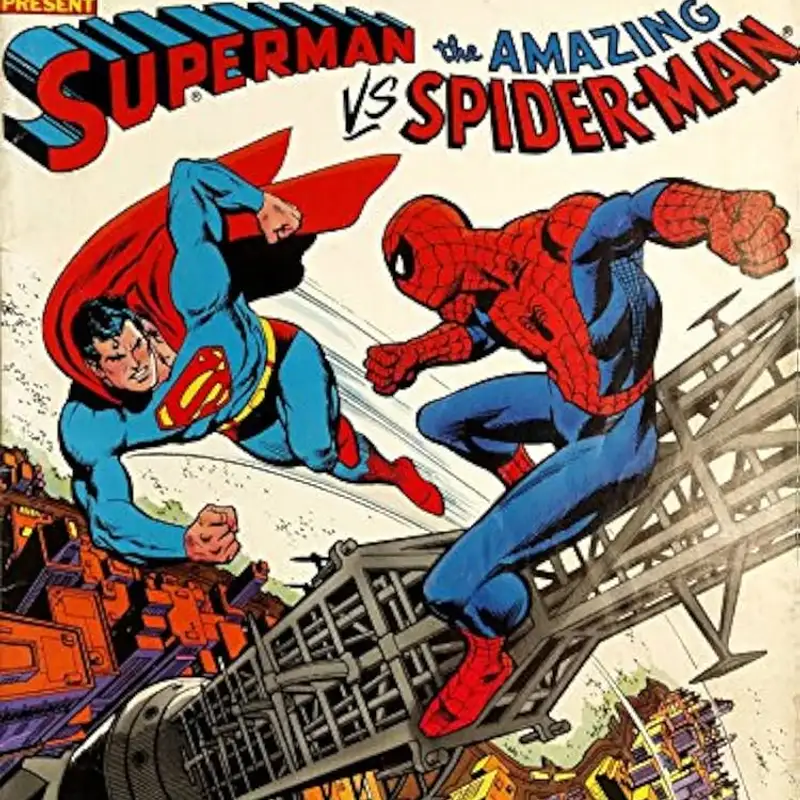
What if Spider-Man fought Superman for a moment before teaming up? From DC & Marvel's Superman vs. The Amazing Spider-Man #1
>> Rob: If you're a superhero and you're not wearing red and blue, are you even doing comics? We ask questions like that here on Dear Watchers, an omniversal comic book podcast where we do a deep dive into the multiverse.
>> Guido: We are traveling with you through the stories, the worlds, the fashions that make up an omniverse of fictional realities we all love. And your watchers on this journey are me, clad in red and blue guido me.
>> Rob: And of course, this is not a video podcast. Audio only, old school here. But I am wearing a red and blue shirt. And it's me, Rob. And I just somewhere in the recesses of my mind, I knew to put on a red and blue shirt today.
>> Guido: And you know, even iconic characters are the reason why. Probably.
>> Rob: Exactly. Well, and speaking of, I can even see. I know behind you there's a Captain Marvel blanket which is also red and blue. So I wonder where she got yellow, which.
>> Guido: Well, at least one of these two characters has a flash of yellow. Yeah. So lots of fashion to discuss in today's episode.
>> Rob: Exactly. But, before we do that, Geeta, what's new in our little section of the Multiverse?
>> Guido: Well, welcome back. We're here again with a real classic issue that we have not covered before, but is also timely. More on that in a moment. But remember, you can also catch us on alternating weeks if you are just craving our voices on the Sleepover retro countdown show where we're counting down nostalgia pop culture. Yes, I was gonna say that. And our faces, because you can see us on video on that show. So check it out if you're interested. Got, lots of nostalgia pop culture episodes over there. But in the meantime, we're excited to dive into this new Earth.
>> Rob: Yes. And if you're joining us here on Dear Watchers for the first time, we have three parts of our journey through the multiverse today. Origins of the story, exploring multiversity, and pondering possibilities. So thanks for coming along and remember.
>> Guido: To leave us a five star review, please, wherever you are listening. And follow us on social media earwatchers.
>> Rob: And with that, welcome to episode 175, and let's check out what's happening in the Omniverse with our travels, today's alternate universe. And today, we are asking the super and amazing, or in some cases spectacular, question if Spider man fought Superman for a moment before teaming up.
>> Guido: Yeah. Wow. It is amazing. And what else is it? I'm trying to think adventurers. That's Superman. He doesn't really have adjectives. So it's Adventures of Superman and Superman. Man of Steel. But we do have Amazing Spider man and Spectacular Spider Man. So lots of S's, thanks to Spidey.
>> Rob: Exactly.
>> Guido: Well, this is an Earth we have covered before because it's sort of the catch all Earth where they just drop all the crossovers just in case they want to share canon, even though they don't really. So crossover Earth on Marvel is 642-7642 and on D.C. is Earth 96. We'll talk more about if this is canonical or if it even should be or not when we get into it.
>> Rob: Because I saw it was also. It was. I was. It was nicknamed, at least by some fans, Earth Dollar Sign. I saw that was. That was the nickname. That's Earth with two lines through it.
>> Guido: Earth Dollar Sign is back in full force as we covered on the previous episode. But we have covered these characters so much. I think. So Spider Man. We launched the show with episode number one. So you can go back and listen to that. I can't even imagine what that sounds like.
>> Rob: It's probably about two hours long if.
>> Guido: I had to imagine two. Enjoy that. And then you could go listen to episode 38 for Superman. But we have covered him probably dozens of times. Most importantly, we have covered lots of Marvel DC crossovers and gave a history of them back in episode 97.
>> Rob: So.
>> Guido: So if you go pull down episode 97, you'll get some of that background and that will include a little bit of how this happened. But of course, this team up is tough to understand how it happened other than dollar signs. And even Gerry Conway agrees with us and we have a quote to kick us off. Go ahead, Jerry Conway read it.
>> Rob: He says, for my money, there was no rational way we were going to justify this team up. I mean, in what universe on what this take place? I looked at it as a chance to do a story for the fans, a fun story. It was a chance to do some scenes as a fan would like to see in this fantasy. So, yeah, this is like fan fanfic.
>> Guido: But legitimate canonical fanfic.
>> Rob: Exactly.
>> Guido: Plenty of that out there and we've talked about a lot of it. But let's dig into this one.
>> Rob: Yeah, let's. Let's get bit by a radioactive spider on Krypton. It's time for origins of the Story. Right now on this very show, you're gonna get the answer to all your questions. Our amazing story begins a few years ago.
>> Guido: All right, so let's talk these two red and blue icons. We don't need to talk first appearances. We've talked about them m plenty of times, but let's just talk about them overall and let's go in chronological order. Superman, of course, being older than Spider man, what do you like about Superman? When are you like, oh yeah, this is my Superman?
>> Rob: Ooh, that's a good question. Because I was never been like a big Superman fan. I think for Superman, it's m all about everything almost around Superman. It's like the ensemble. Like I've always loved Lois and Perry and Jimmy and like the whole, the whole Daily Planet kind of world. And then all the villains. Like the fun thing with Superman is like, you can have a human villain, you can have an alien villain, you can have a mutant villain. Like you can. Because he's so powerful, you can kind of have him face off against anyone. He's almost like a blank slate. Which sounds bad, but in that way you could have him like, you couldn't have Captain America, for example, necessarily fighting some giant superpowered mutant. It would be a little incongruous.
>> Guido: What do you think?
>> Rob: You don't agree or you don't?
>> Guido: Yeah, no, it's clear you're not a huge Superman fan.
>> Rob: Exactly, exactly. No, I just.
>> Guido: It's clear you don't think a lot about the character.
>> Rob: No, I don't. No. I think I fell into that thing too, of reading him after the Death and like the Return, but he just never felt like he had a ton of personality for me, which I know Superman fans would certainly disagree with. But for me, I guess when I was reading him in what that, mid to late 90s, it just wasn't really for me. What about you? Because you are a Superman fan, but you're not like a huge Superman fan, like the way you are with some other characters?
>> Guido: No, I think when I say, oh, that's my Superman, it's the struggling to be a human version of Superman. And I think most recently or somewhat recently Superman and Lois as a TV show did that best. And certainly James Gunn's movie did that, and plenty of writers have done it. But I think that's the aspect of Superman that I love, is that it's not that I think he teaches us morals because he's so moral. It's that I think he teaches us how to be human because he's always struggling to be the best version of a human being he can be. And that is what I feel and find really powerful. So that's my Superman.
>> Rob: Well, what I liked, I think with the two examples you gave, was they were able to Remove a lot of the artifice of him also pretending to be this bumbling, nerdy character and really focused on him. Just what does it mean to be a human regardless? Like, he doesn't also have to pretend to be this other human. It's exploring what it means to be married and have children. On the sake on Superman and Lois. While so many of the other Supermans I grew up with on, Lois and Clark or in the Christopher Reeve movies, there was that extra layer that kind of maybe hid that aspect of it more because he was also pretending to be this other person.
>> Guido: Yeah, I don't even care. I think sometimes that's done well and sometimes it's not.
>> Guido: Because I actually think sometimes if that's done well, that can help you explore like. Well, why does he have to have two Personas? It's because he's trying to figure out what his life is gonna look like. And that's what we're all trying to figure out all the time. So that's the aspect of him that I like. All right, so Spider Man. When is Spider man your Spider Man? When are you reading it and you're like, yeah, there he is?
>> Rob: I think when he's super wisecracking. And I think the thing I always associated most with him was being this kind of nerdy character. And of course, like Peter Parker is often drawn as like a super handsome, like, buff guy. So that's not always the case. But I always kind of got like, when he's Peter, he's a bit more reserved. We actually kind of see that in this issue that we're going to talk about today. He's not that, that super quippy kind of person. And then as soon as he puts on the Spider man mask, he does become this other person and has all the humor and the levity and things like that. So I think I always gravitated to him in that, like, oh, this is his superpower. Is not just his actual superpowers, but then it's his wit and his personality that comes through even without being able to see his face.
>> Guido: Yeah. So if he doesn't have that, he's not your Spider Man.
>> Rob: Yeah, I think, I think because I know also, like, there's been some Spider mans even when I was reading the comic regularly many years ago, it gets into some deep and dark and serious places. And I like my Spider man to be the wisecracking, I'd say.
>> Guido: I think for me it's hard not to just repeat the same answer. Actually, I like Spider man, less than I like Superman. I. There's less of it that I want to read or want to pick back up, but I know that when I enjoy it and I'm like, oh, this is something fun. It is that balancing act. So less about the personality you're describing, but m. The mechanics of what you're describing. The idea that he's. I think what's interesting, and we'll definitely get into this in this issue, is he's not that powerful.
>> Guido: I think that's what makes him a slightly more interesting character. So it's ironic that I have the same answer for the most powerful character, arguably that there is Superman. And one of the weaker characters that there is in Spider Man. Like, are his powers cool? Sure. Does he.
>> Rob: He can lift his villain. He's a car though. She's not super weak.
>> Guido: No, he's not weak. But relative to superpowers, he's not all that mighty and powerful. And so I think when you get to explore that he is like almost essentially, not as much as Batman, but almost essentially a human putting on a mask, going out to do this, I think that's some interesting storytelling for him.
>> Rob: There's some interesting things even, and it's even explored in the issue we're going to talk about where if Clark needs to become Superman, he can basically do it instantly because he's super fast. Like you don't need to explain it. But there's a moment in this issue where spite where Peter has to become Spider man and he has to go up to the roof, he has to put his clothes in like a webbing basket and like hide them. Like there's a lot of like rigamarole he has to go through where basically like Clark can do it instantaneously. So I do like that like he is this normal guy that's also being a superhero and he doesn't have Batman's billions or Superman's speed. He has to kind of actually figure this out in. In real time and like hide his camera and all these things that actually require ingenuity as well as being superpowered.
>> Guido: Yeah, yeah, I agree. I like those moments. So let's get into it and see if we get the things we want from these characters in this monumental historic team up.
>> Rob: Okay. It's time to explore some multiversity. I am your guide through these vast new realities. Follow me and ponder the question, what if? So this is Superman vs the Amazing Spider Man. Colon, the Battle of the Century from Marvel and DC. It is a Treasury sized book. 88 some 88 pages in the version I read.
>> Guido: No, but the size of the book.
>> Rob: Oh, no, I know, I know, but.
>> Guido: The book is actually oversized. That's what a treasury is.
>> Rob: I know that, too. Yes, yes. But I'm saying it's also long. And it came out on in March 1976.
>> Guido: It is written by Gerry Conway, who is also, I, think most famous for creating Captain Marvel or creating Ms. Marvel, but did a lot of other stuff at Marvel. Wrote, unsure. Wrote a whole bunch of titles, wrote Spider Man. Penciled by Ross Andrew. Inked by Dick Giorgiano. Colored by Jerry Serpi. Lettered by Gaspar Saladino. Edited by the hall of Fame of Editors. Because everyone had to have their, their fingerprints on this one. Carmine Infantino from dc, Stan Lee, Roy Thomas from Marvel, Julie Schwartz, dc. Marv Wolfman, DC at the time, E. Nelson Bridwell, Marvel. So lots of editors. But of course, the original edition lists no editor. The splash just reads, presented by Carmine Infantino and Stan Lee. Which was changed to an edited by and later reprints. Back on our history episode, we actually talked a lot about when they did this, how every single thing had to be approved by both. And the amount of time, the amount of panels, all had to be exact. And you can feel all that, which we'll get into in a moment. But in this case, there's even a sketch, and this is in the original edition. They show how the COVID was created. And I love that in the breakdown of how the COVID was created, they show like, Carmine signed off on it and then Stan signed off on it and then they got to the COVID But there were a few people who got involved without credits. So tell us about those.
>> Rob: Yeah, so Neal Adams, another icon, he actually redrew most of Superman in this book. And Dick, Giordano actually recalled to Back Issue magazine. He said the pages were sent to Neal Adams studio. They were mostly left on Dick's desk. And Neil took it upon himself to redraw the Superman figures without telling me that he was going to do it. I didn't complain, but I also never mentioned it to anyone at the time, and I never spoke of it until now. This was just a few years ago, mostly out of respect for Ross and, and his work. Then you had another icon, John Romita Sr. He drew some of the Marvel character faces. He also did some Spider man alterations. Giordano's assistant, Terry Austin inked some backgrounds. And then on three of the pages, someone we actually just met at New York Comic Con this past fall, Bob Wiacheck. Also inked some background. So this is really a who's who of comics from this era.
>> Guido: It is, it is. And so for those who haven't read it recently, let me tell you about the structure. And then, Rob, you can give a little quick overview of the plot. So the structure is that we get a prologue that's Superman in Metropolis, and then it actually breaks for a hero identification, which is like a one page splash page giving his origin. Then the next prologue is Spider man in New York with Dr. Octopus. I should say Superman was against Lex Luthor, of course. And after that prologue, you have another hero identification of Spider Man's origin. You then move into prologue three, which is Lex Luthor and Dr. Octopus. And so it sets up the two of them in prison together and kicks off our tale. And of course, before you get into the real story, you get the villains page, which is like a fun breakdown of each of their origins and the powers or the technology in both third cases that they have. And then you get into it, then you're in the story of the Amazing Spider man versus Superman, and that's it from there on. So what. What do you want to say about what kicks this off or, like, how it functions? Because you are always talking about this trope, and I'd be curious in 1976, like, how established this trope was, but this is definitely, like, the representative example of this trope. So what is that trope that you always talk about?
>> Rob: Oh, no, I don't know what trope I'm always talking about. You're. You're. Well, they're both. They're both reporters, which is the.
>> Guido: What has to happen when they meet each other?
>> Rob: Oh, of course, of course. Well, they have to fight for two minutes before they realize that they're friends and then continue on. Yes, yes.
>> Guido: I mean, some misunderstanding.
>> Rob: Oh, of course.
>> Guido: It's never like, a reasonable, logical fight. Although in this case, it's because Lex Luthor is dressed as Super Superman to kidnap Mary Jane and Lois. And so Spider man, of course, thinks Superman kidnapped them. And I don't know, it's not clear what's one of the crazy things. So there's so much to say. This is set in a world in which they just coexist. Metropolis coexists with New York, but for some reason, Spider man believes Superman would have just kidnapped Mary Jane and Lois. Unclear why, but that's what leads them to fight at that point.
>> Rob: Yeah. And. And, I was also thinking, is Lex wearing a muscle suit or is Lex just in really good shape. And we don't know because he's able to double as Superman in this case.
>> Guido: Yeah, the disguise is quite extensive.
>> Rob: Yeah, well, it's even in the title of this book, which is Superman versus the Amazing Spider man, the battle of the Century. So obviously in all these cases, as you mentioned, there is this trope and it always is around the battle. But in probably the grand scheme of this book, they probably battle for. What would you say, like 10 pages of it? Like, it's pretty. It's pretty brief.
>> Guido: Yeah, well, it needs to be because, backing up. Imagine hearing Superman is fighting Spider Man. it doesn't matter if you're the biggest Spider man fan there is.
>> Rob: Yes.
>> Guido: There's no way you can imagine Spider man could hold his own. So of course they need a device in here to make the fight even remotely level because there is nothing about Spider Man's powers or his cleverness that could actually help him in a fight against Superman. So in this case, Lex has blasted Spider man with red sun radiation so that when Spider man hits Superman, Superman actually feels it. So that's the device which then, of course, in a rather funny moment, wears off at a certain point. And then Spider man hurts his fists.
>> Rob: Yes.
>> Guido: Yeah, that's when their fight wraps up. So it is strange to use the trope of them battling. And like, it's weird that they didn't just make this a team up. I guess they figured fans would want to see a fight. But it does seem very strange to me that they made it a battle. Why do you think it had to be a battle?
>> Rob: I think it's just. What? Because everyone always wants to know who's going to win. I think it's, a major marketing stand. Marketing point. And if you look at the Zack Snyder Superman Batman movie, if you look at, the Avengers, civil war, whatever.
>> Guido: It is, like Batman, you can even argue Batman could win against Superman. Like Superman and Spider man has no powers.
>> Rob: You can argue Batman can win over.
>> Guido: Spider man super advanced technology and is a brilliant, brilliant strategician. So you can imagine, you know, if he gets his hand on some kryptonite or something, like he could totally do it.
>> Rob: Yes.
>> Guido: That's where I just think it's weird that they decided to make this a, battle. And I don't know when the real life, because of course it's a few years later that Superman fights Muhammad Ali. But when is the real life? Isn't there something called the battle of the century with Muhammad Ali or something?
>> Rob: Oh, I think so. Yeah, I mean, there was a real thing.
>> Guido: So I wonder if that was an inspiration or something. But it just seems weird to me that they decide this is what's gonna get fans to buy into this. And so it was. So it's the fight of the century and it was 1971. Joe Frazier, Muhammad Ali. So maybe that was an inspiration. But still there is that storytelling trope that you always talk about, though you forgot today in terms of making them fight first.
>> Rob: Well, and it's always, when do you have it? Or actually in some cases, like something we also covered on the podcast or mention there's like Freddy versus Jason in the horror world and that they end with the fight. Like they're teamed up for most of that movie and then they end, which.
>> Guido: Is an interesting different way to do it. I feel like this issue is the more common way to do it, which is like, oh, we're gonna fight. I don't know what's going on. certainly with. Usually it's I don't know who you are or something. Though in this case, they set them on Earth. So let's talk a little bit about that. My guess is that because in 1976, you still don't have a vast multiverse out there and you don't have super multiversally literate fans. Though of course, DC has multiple Earths. I guess they just decided, like, let's not have some set up. Let's not waste time on, like, how they got together. Let's just set this in an imaginary world where they coexist. Do you. Why do you think that is? And do you think it's the right move here?
>> Rob: I do think it's the right move. And we've talked about before that often the device to get these characters together just is that a, device. And I think it would just have taken up very, very precious real estate in this book, which is already trying to do a lot here. So I kind of like that they just completely ignore this. It is very believable, I think within the world that each city has its own superhero, and New York's got Spider man and the Fantastic Four and Metropolis has Superman, and they just really don't meet up in that way. I think one thing I think that it actually really illuminated for me is the actual device that they use to get them together, which is that they're actually going to some news conference in New York. And I think it's one of the things that stands out for me in this book is showing the similarities between these two characters. So you do have Clark and Peter both working in news and both of them also, because of their superhero identities, being somewhat flakes for their day jobs as well. So I think that, concept where, Clark is missing the big story because he's fighting in the big stories and Peter's trying to set up his camera to photograph his own fights, but it doesn't always work. I think that element actually brings these two characters together in a great way.
>> Guido: See, that was something I did not like about this. I didn't like in part because of that, like, even split, which definitely limits the creativity here because you can even just see, like, the. The pages are almost mirror images of each other. And that, again, came down to their negotiation. But I think while it's an interesting lot to play with, I actually don't think they play with it very well here. And so you just end up with almost the same RePet. It's like Superman with Morgan Edge, who at this point owns the Daily Planet, and Spider man with J. Jonah Jameson. And it's antagonistic. And then you have Lois and MJ on the side. Like, it. It feels so repetitive in a way that I don't like because they never. They never comment on the similarity. They never play with it or do anything with it. So I think putting it through this extremely rigidly structured breakdown, I, don't. I don't love. I think this overall zooming out. I think this story slogs. Yeah, I think it's go. It's like, so I don't even know what it is. It's not overwritten, though. It definitely borders on overwritten, but it just takes so long to get through. The pacing is off. And maybe that's, again, because of this, like, 50, 50 split. And you have these two editorial teams trying to deal with it. Even though you have, in theory, only one writer. I just find that it really drags in a lot of places. And so I think those newspaper similarities, while interesting, are never explored.
>> Rob: Well.
>> Guido: And just to me, add to the like. Okay, come on. I've seen this. Okay, let's keep going. Let's keep going.
>> Rob: So that's my feeling reading about it too. Gerry Conway said that despite the fact that there are 1, 2, 3, 4, 5, 6 people listed as editor, Jerry said that he himself did the bulk of the actual editing on the issue. So perhaps some of it comes down to that where the writer was really kind of editing himself. And maybe all those other people were more chiming in with story ideas and oversight and things like that. So Perhaps a stronger editorial hand, despite six names being mentioned, would have actually been able to steer this story into better. Better direction.
>> Guido: Yeah, that could be true. I also think the other thing you mentioned at the beginning is how long this issue is. It is quite long, and I wonder if that was a mandate and that sort of led to them, Or to Jerry needing to pad it out because, like, they end up going to. I don't know. There's this whole thing with the satellite, and Lex wants to take it over, and it's like, who cares about that? And then you have this whole segue where Spider man and Superman are in Africa because they go to Mount Kilimanjaro. There's this whole encounter with, like, a tribal warrior who wants to fight them. So then they have to fight him.
>> Rob: He's superpowered from the same red ray that gets Spider man superpowered as well. But I didn't quite understand. Was he there just to slow them down from.
>> Guido: Yeah, it's such a weird interlude. Like, so there's lots of moments like that where you're like, okay, why is this in there? Should this have been a chapter in something longer? Or should this have been cut so that this could be something shorter? I'm not sure. So, yeah, I think there's some missed opportunities here. For me, I think one of the.
>> Rob: Biggest missed opportunities, especially since I'm such a villain fan, is the use of the two villains. Like, as you just alluded to. I don't quite know what Lex's plan is. This entire episode issue, it begins with him stealing some digital doodad that then he's putting into this satellite and is requesting all this money, but then just wants to destroy the world. And then I think it's. It says something that in all of this, we're barely or really not mentioned almost at all. Dr. Octopus, who's the other villain in this, but is really on the sidelines, we don't really get much of him. And I think there could have been a lot of opportunity to also explore the similarities between those two characters. And I think you then ultimately get another kind of trope that you see all the time here, which is that in the end, Lex is going to just destroy the world. And Doc Ock, even though he's a bad guy, you know, he's not as bad as wanting the whole world to be destroyed. So he actually then lends one of his many arms into helping out and defeat Lex. And I think that's something you see all the time as well. Like the secondary villain Stepping up and actually joining the heroes, at least temporarily, to help save the day.
>> Guido: Yeah, and even that battle could have been more interesting because they actually swap each other's villains, but they don't even go into why. So, like, Superman goes after Doc Ock and Spider man goes after Lex. Like, you'd think you'd come up with some clever story reason for doing that, or the trope would be, I guess, like, they're not used to you. Lex is exactly used to Superman, Doc Ocka used to Spider Man. But they don't even really play with that very much in that, battle, which is not even the final battle, because, of course, then they have to go fight a tidal wave. So it's not very exciting. I like that they had to define what a tsunami was. I guess in 1976, people weren't as familiar with tsunamis. So there's an editorial note for what a tsunami is, but. Yeah, well, I think.
>> Rob: I think, like, the villains, too. I would have loved to seen maybe a little bit more page time given to Lois and Mary Jane as well, because there's little hints of that they are going through similar trials with the men in their lives where Peter's always running off and Clark just doesn't want to stand up for himself and things like that. And the only moment we get between them is like, a cat fight, a mini, like, you know, ah, we're about to fight because we're too, like, jealous women. So it would have been nice to actually given these characters a space to bond and. And find their own common ground.
>> Guido: Yeah, well, I think, seeing that, then it has this epilogue that I thought more of that. Exactly. Exact thing was going to happen with, like, the other characters, and it doesn't. It made me think of the Deadpool, Batman, Batman, Deadpool that we covered, where it almost felt like this was, like, part one, and then there could have been a part two that, like, gives you more of those character beats. Now there is a part two, and we'll talk about it in our next segment. But it does not satisfy that need. So. So it does. well, we're not really counting it, and we'll talk about that in a moment. So, yeah, I think all of that was missing. And so I'd say, overall, I mean, it's got a great look and of course, it's fun to see this, but I don't think this issue does a great job with bringing these two iconic characters together in a historic event.
>> Rob: Yeah, I agree. It's a fine read. It's certainly not painful. And I think the highlight of it often is the really classic art from Ross, Andrew and Dick Giordano and all these other uncredited people apparently. Like, it just has super classic look. And like any book that's gonna begin with Lex and a giant robot and there's a giant tsunami, it's got tons of classic, especially Superman beats in it in that way that it's fun to see on the page.
>> Guido: And some great pinup art between the splash pages and the front and then the closing cover. It's got some great pinup art, though.
>> Rob: Spider man calls Doc Ock fat at one point, and the Doc Ock as he's drawn in, this is quite svelte. So I don't know Peter's fat shaming for Otto here. Let's wrap up by talking about some pondering possibilities. Will the future you describe be averted? Diverted? Averted? So, Guido, what are we talking about for pondering possibilities?
>> Guido: So there is a sequel that I suspect would have come out faster if not for corporate stuff. It didn't come out till 81, and I don't quite see it as a sequel. I think because it's set in a world where these two characters know each other. Again, it feels like a sequel, but there's no reference, as far as I'm aware, to this issue. And maybe we'll cover it one day on another episode, but it's not good. It's Dr. Doom and Parasite, which you'd think would be a better choice, but it's just not great. And so we're going to leave that out and set that to the side. But now, this year, in fact, just two months away from when we're recording this, we're getting more. I doubt their sequels, but we're getting Spider Man, Superman and Superman Spider man again, just like we got Deadpool Batman. So two big issues with massive teams with dozens and dozens of variant covers. And, of course, these two characters were missing from the Deadpool Batman resurgence of 2025. So now we're gonna see what happens when they connect.
>> Rob: So.
>> Guido: What do you want out of those issues coming out this spring? Is it best to just let them meet? Is it a sequel to this? Do they just coexist? Is there a device? We got a range of those kinds of stories in the Batman Deadpool issues, but these two are the, icons. So what do you. What do you want?
>> Rob: Yeah, I don't think there needs to be a device without getting into, like, the broader storytelling that you saw in, say, like, the Amalgam, books in the 90s and things like that. I think it would be fine for them just to coexist. And as we mentioned, although you thought it wasn't fully explored in this book that we just discussed, they do have this commonality between their tate jobs, if you will. So I think that alone could be something that you could use as a jumping off point.
>> Guido: Yeah, I'd almost be more interested in one of the stories being like a Peter Parker Clark Kent story than a Spider Man Superman story. I think that would be really interesting and fun and sort of background the other stories that background the heroing and center the real life stuff and explore some of the connections and relationships or tensions through that. I hope someone does that in one of these two huge issues that I'm eager to read.
>> Rob: Hopefully they spread this out over the issues. But I think one thing that wasn't really taken advantage of in the book that we just read is that they both have this great deep rose gallery of characters of villains. And Lex and Dr. Octopus are kind of like, okay, like they're the obvious choices. But I'd love to see some of the greater, deeper bench villains that both of these characters have and have almost like a Sinister Six kind of team that goes up against them especially could make sense because if you have Superman and Spider man together, like that's a pretty powerful force. So you might need multiple villains. And maybe it's a Sinister Six made up of six Superman villains. Ah. I mean, three Superman villains and three Spider man villains. Something like that would be very fun.
>> Guido: Yeah, I think it would be fun if they certainly play with more characters than they did in this or than they even did in the Batman Deadpool stuff. I mean, they kept that pretty tight and that worked fine there.
>> Rob: I think that works.
>> Guido: this one I think could benefit from pulling in a whole bunch of other characters. So I am curious, do you think. I mean, these are probably the two most famous characters from each company, so it's interesting that they didn't lead this resurgence of crossovers with them. They led the original crossovers with them, which is what we just read. I'm curious why they started with Batman Deadpool and then sort of built up toward Spider Man Superman. I'm, not sure.
>> Rob: Yeah, I don't know. I mean, I would imagine. I think what we talked about a bit in the past covering Batman Deadpool, is that those characters personalities play so well off of each other. And I think that's something that you don't quite get here. Yes, Spider man is wisecracking like Deadpool, but not nearly as much. Yes, Superman is serious, like Batman, but also not nearly as much. So I think they went with those two personality extremes in the other books, which plays so well. And here they don't have that card to play as much in these books, in these upcoming books.
>> Guido: So it definitely makes me wonder, maybe there's some other way they're going to creatively tell the story. Maybe someone had my idea of having Clark and Peter be the team ups. Or have, Ma m Kent and Aunt, May.
>> Rob: Yeah, I think that would be fun. Well, yeah, I think what would benefit them here is what we didn't get enough from this one in 76, which is lean into not their differences like Batman and Deadpool, but their similarities, from their jobs to their wives, girlfriends, to the parental figures in their lives, to them trying to be fathers and good people while still having these powers. I think, like, if they lean into all that, there's a lot of material there to mine.
>> Guido: Yeah. Yeah. All right. Well, we will surely cover those issues when they come out. But in the meantime, Dear Watchers, that is a wrap. Thank you for listening. I have been clad in red and blue.
>> Rob: Guido and I have been clad in blue and red. Rob.
>> Guido: The reading list is in the show Notes. Follow us us, on social media at Dear Watchers and leave us a.
>> Rob: Five star review wherever you listen to podcasts. We'll be back soon with another trip through the multiverse.
>> Guido: In the meantime, in the words of Watu, keep pondering the possibilities.
Creators and Guests